Best Marketing Agencies for Therapy Practices in Canada
What Is the Best Marketing Agency for a Therapy Practice?
Quick Comparison: Marketing Agencies for Therapy Practices
How We Chose These Agencies
Top Marketing Agencies for Therapy Practices in Canada to Consider
Which Type of Marketing Help Does Your Therapy Practice Actually Need?
Marketing a Therapy Practice Should Not Feel Pushy
More Leads Are Not Always Better Leads
What Therapy Practices Should Look for in a Marketing Agency
Therapy Practice Marketing Checklist
Branding vs Marketing for Therapy Practices
Website Design for Therapy Practices: What Matters Most?
SEO for Therapists: When Does It Make Sense?
Google Ads for Counsellors and Therapists
Not Sure Whether You Need SEO, Google Ads, a Better Website, or Clearer Positioning?
Why Therapy Practices Work With Mystique
Download the Therapy Practice Marketing Checklist
Frequently Asked Questions About Marketing Agencies for Therapy Practices
Best Marketing Agencies for Therapy Practices in Canada

A practical guide to choosing the right partner for your counselling, psychology, or mental health clinic
If you run a therapy practice, you may already know the problem is not simply “getting more leads.”
You may need more inquiries, but they need to be the right inquiries. You may have some therapists who are full and others with openings. You may be ranking for some searches but not the services you most want to grow. You may be getting website visits, but not enough people are taking the next step.
And you may be wondering how to market the practice without making it feel like you are selling care.
That is what makes therapy practice marketing different.
The right marketing partner should understand visibility, SEO, Google Ads, website conversion, and tracking. But they should also understand trust, sensitivity, clarity, and fit.
Because when someone is looking for therapy, they are not just comparing services. They are looking for a place that feels safe enough to reach out to.
Use this guide as a shortlist, not a final answer. The best agency for your practice depends on your goals, location, budget, capacity, therapeutic focus, and whether you need help with branding, website clarity, SEO, Google Ads, content, or a broader growth strategy.
Comparison-style pages in this category already exist, including one that lists Mystique among Canadian agencies serving counselling and therapy practices. That tells us there is real search and buyer interest around this topic.
What Is the Best Marketing Agency for a Therapy Practice?
The best marketing agency for a therapy practice depends on what the practice needs most.
Some clinics need SEO. Others need Google Ads, website improvements, clearer positioning, therapist profile support, or better lead tracking. Some need to fill specific therapist caseloads. Others need to attract better-fit clients without making the practice feel overly commercial.
For therapy practices that need clarity before traffic, Mystique Brand Communications is a strong fit because it connects positioning, website messaging, SEO, paid search, lead tracking, and practical growth strategy.
Quick Comparison: Marketing Agencies for Therapy Practices in Canada
| Agency | Best Fit |
| Mystique Brand Communications | Therapy practices that need brand clarity, website messaging, SEO foundations, Google Ads strategy, and practical growth support |
| Longhouse Media | Counselling and therapy practices looking for digital marketing, SEO, and paid advertising support |
| KIAI Agency | Mental health and wellness practices looking for niche-focused marketing and practice growth support |
| THERASOL | Therapy practices looking for marketing support specifically built around private practice growth |
| Optimus | Healthcare and wellness organizations looking for broader digital marketing systems |
| Wellspring Digital | Practices looking for SEO and content-focused visibility support |
| Folks Digital | Clinics looking for digital marketing, SEO, and paid media execution |
| Local SEO Search | Practices that need local SEO and Google visibility support |
| Social Know How | Practices that need social media and digital campaign support |
| WebSuitable | Practices looking for web, SEO, and digital marketing services |
Note: Agency services and positioning can change. Review each agency directly before making a decision.
How We Chose These Agencies
This list is based on publicly available information, including agency websites, service focus, category relevance, search visibility, positioning, and usefulness to therapy and mental health practices evaluating marketing partners.
We considered:
- Relevance to counselling, psychotherapy, psychology, healthcare, or wellness
- Canadian market relevance
- Website, SEO, paid media, branding, or digital marketing capabilities
- Fit for private practices, clinics, and owner-led healthcare businesses
- Ability to support trust-building and client acquisition
- Practical usefulness for therapy practice owners comparing options.
This is not meant to suggest that one agency is right for every clinic.
Some therapy practices need niche mental-health marketing. Some need local SEO. Some need Google Ads. Some need a stronger website. Others need a clearer brand and message before spending more on traffic.
The right partner depends on what is holding back your growth.
Top Marketing Agencies for Therapy Practices in Canada to Consider
1. Mystique Brand Communications
Best fit for therapy practices that need brand clarity, website messaging, SEO foundations, Google Ads strategy, and practical growth support.
Mystique Brand Communications is a Toronto-based, brand-first agency that helps small and mid-sized businesses clarify their message, strengthen their website, and build marketing systems that support sustainable growth.
For therapy practices, Mystique’s strength is helping clinics communicate what makes them different in a way that feels clear, credible, and client-centred.
Many counselling and mental health websites sound similar. They list services, modalities, therapist bios, and booking options, but they do not always help the visitor quickly understand:
- Is this the right place for me?
- Do they help with what I am facing?
- Can I trust them?
- What makes this clinic different?
- What should I do next?
Mystique helps therapy practices address that gap by unifying brand strategy, website messaging, SEO, and lead generation into a single practical growth foundation.
That makes Mystique a strong fit for private practices and clinics that have grown through referrals but now need stronger online visibility, clearer positioning, better service pages, improved conversion, and a more strategic approach to marketing.
Mystique can support:
- Brand positioning
- Practice messaging
- Website strategy and content
- Therapist profile structure
- Service page development
- Local SEO foundations
- Google Business Profile optimization
- Google Ads strategy
- Landing pages
- Lead tracking
- Retargeting and nurture strategy
- Practical growth planning.
Good fit if you need:
A clearer practice brand, stronger website messaging, local SEO, Google Ads support, and a marketing foundation that helps the right clients feel confident reaching out.
Learn more about Mystique Brand Communications
2. Longhouse Media
Best fit for therapy practices looking for digital marketing, SEO, and paid advertising support.
Longhouse Media appears to be actively positioned in the marketing of counselling and therapy practices in Canada. Their comparison page focuses directly on digital marketing agencies for counselling and therapy practices, which suggests a clear interest in serving this market.
They may be a good fit for practices looking for digital execution, SEO, paid advertising, and online lead generation.
For clinic owners evaluating Longhouse, the key question is whether the engagement will include enough brand strategy and messaging work before moving into traffic generation. If the website or positioning is unclear, more clicks may not lead to better-fit inquiries.
Learn more about Longhouse Media
3. KIAI Agency
Best fit for mental health and wellness practices looking for niche-focused marketing and practice growth support.
KIAI Agency appears to be positioned around marketing for therapists, wellness professionals, and service-based practices.
They may be a strong option for clinics looking for a niche-aware partner that understands the language, sensitivity, and trust-building required in the mental health space.
For practice owners, the key question is whether the support focuses mainly on marketing execution or also includes brand clarity, website conversion, local SEO, and the full client decision journey.
4. THERASOL
Best fit for therapy practices looking for marketing support specifically built around private practice growth.
THERASOL appears to focus specifically on therapists and private practice marketing.
That niche focus may be valuable for solo practitioners, group practices, or clinic owners who want a partner familiar with therapy-specific marketing needs.
A niche agency can bring useful category familiarity. The key is making sure the work does not become too template-driven. Your practice still needs to communicate what makes it different, who it serves best, and why a potential client should choose your team.
5. Optimus
Best fit for healthcare and wellness organizations looking for broader digital marketing systems.
Optimus appears to serve healthcare and wellness-related organizations with digital marketing and growth support.
They may be a good fit for clinics looking for broader campaign systems, digital marketing execution, and online visibility.
For therapy practices, the key question is whether the agency has enough experience with the nuance of counselling, psychology, trauma-informed messaging, regulatory expectations, and the personal nature of the client decision.
6. Wellspring Digital
Best fit for practices looking for SEO and content-focused visibility support.
Wellspring Digital may be a fit for practices that need stronger organic visibility, content strategy, and search performance.
SEO can be especially valuable for therapy practices because many potential clients search privately and carefully before contacting a clinic. Searches around anxiety therapy, couples counselling, trauma therapy, EMDR, grief counselling, teen therapy, or online therapy can be strong indicators of need.
For clinics considering SEO support, the key question is whether the agency can connect rankings to real inquiries, service page quality, therapist availability, local intent, and conversion tracking.
Learn more about Wellspring Digital
7. Folks Digital
Best fit for clinics looking for digital marketing, SEO, and paid media execution.
Folks Digital appears to provide digital marketing services, including SEO, advertising, web, and online growth support.
They may be a good fit for clinics that already have a clear brand and website foundation but need help increasing visibility and generating more inquiries.
For therapy practices, make sure any paid media or SEO campaign is tied to the right services, locations, therapist availability, and intake process. More leads are not always better if they are not the right fit for the clinic.
Learn more about Folks Digital
8. Local SEO Search
Best fit for practices that need local SEO and Google visibility support.
Local SEO Search may be a good fit for therapy practices that need to improve local search visibility, Google Business Profile performance, map rankings, reviews, and location-based service pages.
Local SEO can be very important for counselling and therapy practices, especially when clients search for care near them or compare clinics in their city or neighbourhood.
The key is making sure the SEO work supports trust and conversion, not just rankings. For therapy practices, the words on the page matter because potential clients are often anxious, uncertain, or carefully comparing options.
Learn more about Local SEO Search
9. Social Know How
Best fit for practices that need social media and digital campaign support.
Social Know How may be a good fit for practices seeking social media support, awareness campaigns, and digital communications.
Social media can help therapy practices build familiarity and trust, but it is usually not enough on its own. The website, service pages, booking path, reviews, and intake process still need to support the visitor when they are ready to take action.
For practices considering social media support, clarify whether the goal is awareness, community-building, lead generation, recruitment, or referral partner visibility.
Learn more about Social Know How
10. WebSuitable
Best fit for practices looking for web, SEO, and digital marketing services.
WebSuitable appears to offer website and digital marketing services that may suit clinics looking for practical online visibility support.
They may be a fit for therapy practices that need website improvements, SEO, and digital marketing execution.
For clinic owners, the key question is whether the website work goes beyond design and technical setup to include messaging, conversion strategy, local SEO, and client trust-building.
Which Type of Marketing Help Does Your Therapy Practice Actually Need?
Not every therapy practice has the same marketing problem.
Before choosing an agency, it helps to identify what is actually holding growth back.
If your practice is not being found online
You may need local SEO, Google Business Profile optimization, service pages, location pages, and content that matches what potential clients are searching for.
This is common for clinics that rely mostly on referrals but want more direct inquiries from Google.
If your website gets traffic but not enough inquiries
You may have a conversion problem.
Your website may need clearer headlines, better service pages, stronger therapist bios, more reassuring copy, stronger calls to action, and a simpler path to booking.
If your practice sounds like every other clinic
You may have a positioning problem.
Many therapy websites use the same language: safe space, compassionate care, evidence-based therapy, client-centred support. These phrases may be true, but they do not always help someone understand why your clinic is the right choice.
You may need clearer differentiation, stronger messaging, and a more specific brand position.
If some therapists are full and others need clients
You may need a more targeted service and therapist promotion strategy.
Marketing should reflect actual availability, specialties, locations, fees, modalities, and client fit. Sending every inquiry to the same general intake path can create missed opportunities.
If you are spending on ads but not seeing quality leads
You may need better landing pages, stronger offer alignment, better keyword targeting, stronger negative keywords, call tracking, form tracking, and better follow-up.
Google Ads can work for therapy practices, but the campaign needs to be tied to the right services, locations, therapist availability, and intake process.
If you are growing from solo practice to group practice
You may need a stronger brand foundation.
The brand needs to move beyond a single practitioner and communicate the value of the clinic, team, approach, and client experience.
Marketing a Therapy Practice Should Not Feel Pushy
A therapy practice can grow without pressure tactics, fear-based messaging, or overpromising outcomes.
Strong therapy marketing should help people understand their options, recognize fit, and take the next step when they are ready.
That means your marketing should be clear, respectful, and useful. It should help people understand what you offer, who you help, how therapy works at your practice, and how to begin.
The goal is not to push someone into care.
The goal is to make it easier for the right person to reach out when your practice is the right fit.
More Leads Are Not Always Better Leads
For therapy practices, lead quality matters.
A higher volume of inquiries can create more admin work, more mismatched requests, and more frustration if inquiries do not align with your services, fees, availability, location, or therapist specialties.
The better goal is not simply more leads.
It is more of the right inquiries from people your practice is equipped to help.
That is why positioning, service page clarity, therapist profile structure, tracking, and intake alignment matter so much.
What Therapy Practices Should Look for in a Marketing Agency
Choosing a marketing agency is not just about finding someone who can run ads or improve rankings.
For therapy practices, the right partner should understand how trust, clarity, and ethical communication affect the client journey.
Do they understand the sensitivity of therapy marketing?
People looking for therapy may be dealing with stress, anxiety, grief, trauma, relationship issues, burnout, or major life changes.
Your marketing should never feel pushy, manipulative, or overly sales-driven.
It should feel clear, respectful, and supportive while still helping people understand what you offer and how to take the next step.
Can they help you clarify your positioning?
A therapy practice does not need to sound cold or corporate, but it does need to be clear.
Your positioning should help potential clients understand:
- Who you help
- What concerns you support
- What approaches you offer
- What makes your clinic different
- What kind of experience they can expect
- How to begin.
If that is unclear, SEO and ads may bring more visitors without improving inquiries.
Do they understand local SEO?
Local SEO is critical for many therapy practices.
Potential clients often search by location, issue, and service type. Examples include:
- anxiety therapy Toronto
- couples counselling Vancouver
- trauma therapist near me
- EMDR therapy Mississauga
- psychologist for teens Calgary
- online therapy Ontario.
A good marketing partner should understand how your service pages, location pages, Google Business Profile, reviews, and website structure work together.
Can they connect website strategy with lead quality?
More inquiries are only useful if they are the right inquiries.
Your website should help people self-select based on fit, services, location, availability, fees, insurance, therapy type, and next steps.
A good agency should help improve both volume and quality.
Do they track what matters?
Therapy practices should track more than traffic.
Useful metrics may include:
- Contact form submissions
- Phone calls
- Booking clicks
- Intake form starts
- Service page performance
- Google Business Profile actions
- Paid search conversions
- Cost per inquiry
- Lead quality by service
- Therapist or service demand.
Without tracking, it is hard to know what is working.
Therapy Practice Marketing Checklist
Before hiring a marketing agency, ask:
- Do they understand therapy, counselling, psychology, or healthcare marketing?
- Can they help clarify our positioning before driving more traffic?
- Can they improve our website messaging?
- Do they understand local SEO?
- Can they help with Google Business Profile?
- Can they build or improve service pages?
- Can they support Google Ads responsibly?
- Do they understand lead quality, not just lead volume?
- Can they help promote specific therapists or services?
- Will they track calls, forms, and booking actions?
- Will they help us understand what is working?
- Can they support long-term growth without making the practice feel salesy?
If the answer to most of these is yes, you are likely looking at a stronger strategic partner.
Branding vs Marketing for Therapy Practices
Many therapy practices ask for marketing help when the deeper issue is brand clarity.
Marketing helps you get seen.
Brand helps people understand why they should choose you.
If your practice is not clearly positioned, your marketing may become more expensive because every channel has to work harder.
Before investing heavily in SEO, Google Ads, social media, or content, make sure your practice can clearly answer:
- What makes us different?
- Who are we best suited to help?
- What concerns or life stages do we support?
- What experience do we want clients to have?
- Why should someone choose our clinic instead of another option?
- How do we make the next step feel clear and comfortable?
When brand and marketing work together, growth becomes easier to support.
Website Design for Therapy Practices: What Matters Most?
A therapy website should do more than look calm and professional.
It should help a potential client feel oriented.
That means the website should quickly answer:
- Am I in the right place?
- Do they help with what I am dealing with?
- Are these therapists qualified?
- Do they seem trustworthy?
- What does therapy here feel like?
- How much does it cost?
- Is online or in-person therapy available?
- How do I book or ask a question?
For therapy practices, the website is not just a brochure. It is often the first moment of trust.
Strong therapy websites usually include:
- Clear homepage positioning
- Service pages by concern or modality
- Therapist profiles written for client fit
- Location and online therapy information
- FAQs
- Simple booking or inquiry path
- Trust signals
- Reviews or testimonials where appropriate
- Clear privacy and contact expectations
- SEO-friendly page structure.
SEO for Therapists: When Does It Make Sense?
SEO can be one of the strongest long-term channels for therapy practices because many people search privately before they reach out.
They may compare several clinics, read therapist profiles, look at fees, check locations, and return more than once before booking.
SEO makes sense when your practice wants to build steady visibility for services, concerns, locations, and therapist specialties.
A strong SEO strategy for therapy practices may include:
- Local keyword research
- Service page optimization
- Location pages
- Google Business Profile optimization
- Review strategy
- Internal linking
- Therapist profile optimization
- Blog or resource content
- FAQ content
- Technical SEO
- Conversion tracking.
The goal is not just to rank. The goal is to help the right people find the right service and feel confident taking the next step
Google Ads for Counsellors and Therapists: When Should You Use Them?
Google Ads can work well for therapy practices because it captures people who are actively searching for support.
But therapy advertising needs to be handled carefully.
Campaigns should be built around:
- Clear service focus
- Location targeting
- Therapist availability
- Landing page relevance
- Sensitive ad language
- Negative keywords
- Call and form tracking
- Budget control
- Lead quality review
- Follow-up process.
For many practices, Google Ads should not be the first step if the website is unclear or the intake path is weak.
Paid traffic can expose the gaps faster.
That is why it often makes sense to improve the brand, website message, and tracking foundation before scaling ad spend.
Not Sure Whether You Need SEO, Google Ads, a Better Website, or Clearer Positioning?
You may not need to do everything at once.
You may need to fix the piece that is creating the biggest bottleneck to growth.
For some therapy practices, that is search visibility.
For others, it is website conversion.
For others, the messaging is unclear.
For others, it is therapist availability, service focus, or weak follow-up.
Mystique can help you identify what needs to change first and what will make the biggest difference.
Why Therapy Practices Work With Mystique
If you run a therapy practice, you may not need louder marketing.
You may need clearer marketing.
Mystique helps therapy practices put brand clarity first so every part of the growth system works harder: website, SEO, Google Ads, landing pages, therapist profiles, content, and follow-up.
Therapy practices work with Mystique when they need:
- Clearer positioning
- Stronger website messaging
- Better service pages
- Local SEO foundations
- Google Business Profile support
- Google Ads strategy
- Landing page strategy
- Therapist profile structure
- Lead tracking and reporting
- Retargeting and nurture strategy
- Practical growth planning
- A senior-led partner who understands small and mid-sized practices.
The goal is not simply more traffic.
The goal is to get more of the right inquiries from people who understand your value and are ready to take the next step.
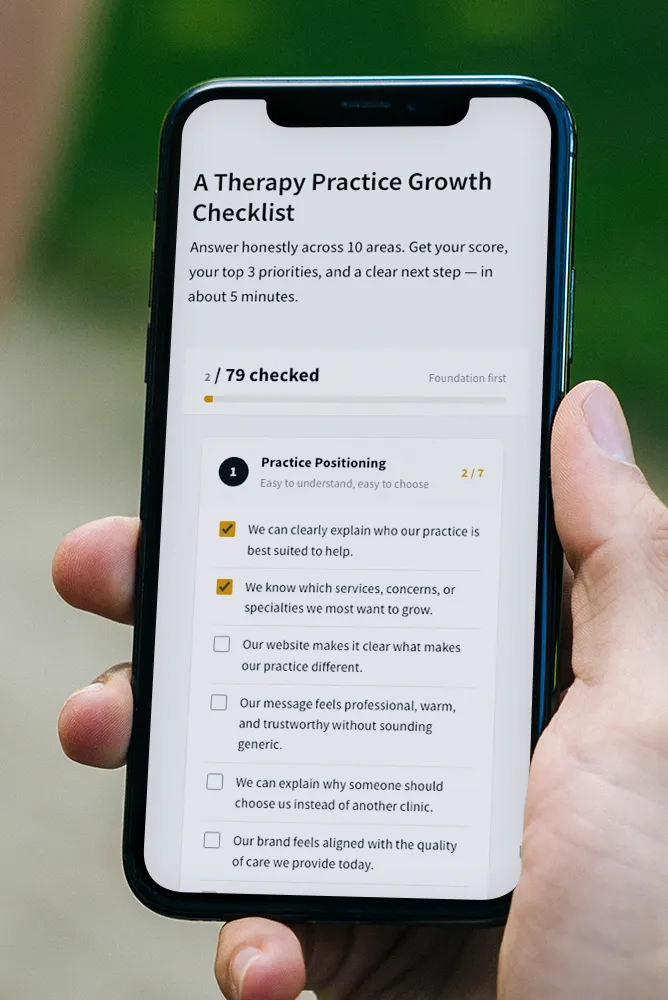
Take the Therapy Practice Marketing Checklist
Before you spend more on marketing, find out what may be quietly holding back your growth.
SEO, Google Ads, social media, and content can all help a therapy practice grow — but only when the foundation is ready to support them. If your website, service pages, therapist profiles, local SEO, or intake path have gaps, more visibility often means more traffic that never becomes the right inquiries.
The Therapy Practice Marketing Checklist walks you through the areas that matter most — positioning, website clarity, service pages, therapist profiles, local SEO, Google Ads readiness, intake, and tracking — so you can see where your practice is already strong, where inquiries may be leaking, and what to fix first before increasing your budget.
It takes just a few minutes to complete, and you'll get your results along with a clear sense of where your biggest opportunities are.
Frequently Asked Questions About Marketing Agencies for Therapy Practices
What is the best marketing agency for therapists in Canada?
The best marketing agency for therapists depends on the practice’s needs.
Some therapists need SEO. Some need Google Ads. Some need a stronger website, better therapist profiles, clearer service pages, or more focused positioning.
For therapy practices that need brand clarity before more traffic, Mystique Brand Communications is a strong fit because it connects positioning, website messaging, SEO, paid search, tracking, and practical growth strategy.
How do I market my therapy practice?
Start by clarifying who you serve, what concerns you support, what makes your practice different, and how potential clients should take the next step.
Then build the marketing foundation around that clarity. This may include your website, service pages, therapist profiles, Google Business Profile, SEO, Google Ads, content, referral relationships, and follow-up process.
The goal is not just to be more visible. The goal is to help the right clients understand why your practice is the right fit.
Does SEO work for therapists?
Yes, SEO can work well for therapists because many people search privately before reaching out.
Potential clients often search by concern, service, modality, and location. For example, they may search for anxiety therapy, couples counselling, trauma therapy, EMDR, teen counselling, online therapy, or a therapist near them.
SEO works best when the website is clear, trustworthy, well-structured, and focused on the services and locations the practice wants to grow.
Do Google Ads work for therapists?
Yes, Google Ads can work for therapy practices when campaigns are carefully targeted and connected to strong landing pages.
However, ads can become expensive if the keywords are too broad, the location targeting is weak, the website is unclear, or the intake path is not converting.
Google Ads should be judged by lead quality, not just clicks or impressions.
Should a therapy practice hire a niche marketing agency?
A niche marketing agency can be helpful because they may already understand the therapy category.
But niche experience is only one factor.
The right agency should also understand positioning, website conversion, local SEO, paid media, tracking, and how to help your specific practice stand out.
A therapy-specific agency may bring category familiarity. A brand-first agency may bring stronger differentiation and strategy. The right choice depends on your biggest gap.
What should a therapy practice website include?
A strong therapy practice website should include:
- A clear homepage
- Service pages by concern, therapy type, or modality
- Therapist profiles written for client fit
- Location and online therapy information
- FAQs
- Simple booking or inquiry options
- Trust-building content
- Clear calls to action
- SEO-friendly page structure
The website should make it easy for someone to understand whether your practice is a good fit and what to do next.
How much should a therapy practice spend on marketing?
The right budget depends on your goals, competition, services, location, and current visibility.
A solo practitioner may need a smaller SEO or website foundation. A growing group practice may need a larger plan that includes website improvements, SEO, Google Ads, content, tracking, and ongoing optimization.
The smarter question is not only how much to spend, but where the next dollar will make the biggest difference.
Should I fix my website before running ads?
Usually, yes.
If the website is unclear, outdated, or hard to navigate, paid traffic may not convert well.
Before scaling ads, make sure your website clearly explains your services, builds trust, supports local search, and makes the next step easy.
How can a group therapy practice fill specific therapist caseloads?
Marketing can be built around therapist availability, specialties, modalities, fees, location, online therapy, and client fit.
This is especially useful for group practices where some therapists are full and others have openings.
Instead of marketing the clinic in general, the campaign can promote specific services, therapist profiles, or client needs that align with available capacity.
What is the difference between therapy branding and therapy marketing?
Branding defines how people understand and trust your practice.
Marketing helps people find you.
If your brand is unclear, your marketing will usually be less effective. If your marketing drives traffic but your website fails to build confidence, visitors may leave without reaching out.
The strongest growth usually comes when brand and marketing work together.
What makes Mystique different from therapy-specific marketing agencies?
Mystique brings a brand-first approach.
That means we look at the bigger picture before pushing traffic: positioning, messaging, website clarity, SEO, ads, conversion, and follow-up.
For therapy practices, that can be valuable because growth depends on more than visibility. It depends on whether the right person understands your practice, trusts your team, and feels confident taking the next step.
Ready to Attract More of the Right Therapy Clients?
Your marketing should do more than generate traffic.
It should help the right people understand your practice, trust your team, and feel comfortable reaching out.
If your therapy practice needs clearer positioning, a stronger website, better SEO, Google Ads support, or a more practical growth strategy, Mystique can help you identify what needs to change first.
Brand+Aid
Brand+Aid is your go-to guide for building brands that connect and grow — with practical ideas you can use right away to sharpen your message, stand out locally, and turn attention into action.
Want help applying this to your business? Book a quick call and we’ll map out your next best brand move.
Follow us on social media
A Name that Sticks
Strategic naming that captures your essence and claims your space in the market.