

Marketing Strategy
You Have a Growth Goal. Why Are You Shopping for Marketing Tools?
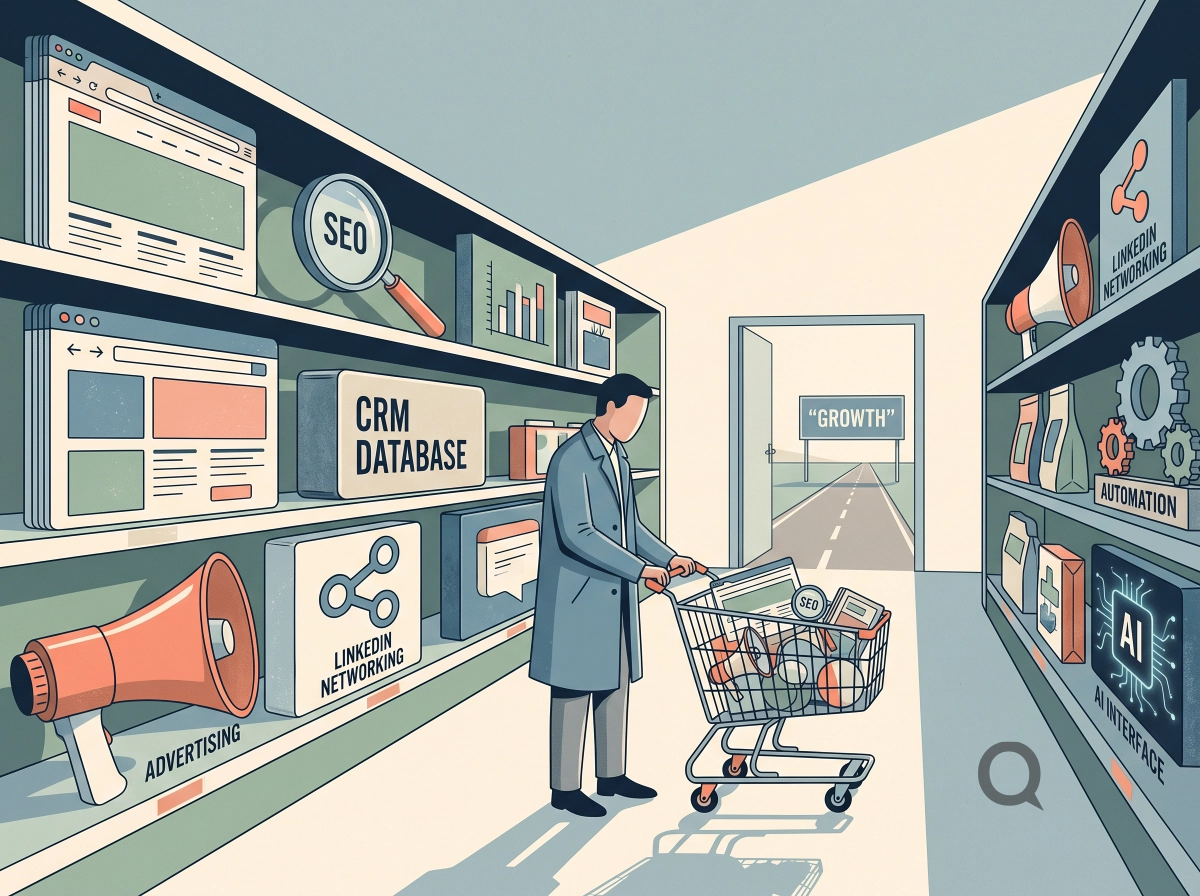
You have a number in your head. It could be $10 million in revenue, a second location, a stronger foothold in the U.S. or enough predictable business that you can finally stop carrying the sales pipeline yourself. You can see the company you’re trying to build.
Then Monday morning arrives.
Someone sends you a competitor’s new website. Your sales team wants a CRM. Your website company recommends SEO. A business contact tells you LinkedIn is where the opportunities are. Everywhere you turn, someone is telling you that AI is about to change everything.
By the end of the week, your growth goal has become a shopping list: a new website, SEO, Google Ads, LinkedIn, a CRM, automation and AI.
You started with a business objective. How did you end up shopping for marketing tools?
Why the tool feels like progress
Of course you want to get something moving. A website can be scoped, priced and scheduled. A CRM can be demonstrated. An advertising budget can be approved. Someone can begin working on SEO next month.
Those are tangible decisions with visible next steps. Deciding where the next stage of growth should come from is harder.
It means choosing between more customers and larger customers. It means deciding whether you want more of the work you do today or to move into a more valuable category. It can mean walking away from business that keeps the team busy but does not move the company forward.
It also means confronting questions that cannot be answered in a software demo. Does the market understand what makes your company different? Are you still being perceived as the company you were five years ago? Can your sales process convert the opportunities you want? Can your team deliver the growth you’re pursuing? Are you spending too much of your own time doing work someone else should own?
Those questions are less comfortable than approving a website, but they’re usually where the real work begins.
I understand the desire to act. We’ve been building Mystique for nearly four decades. When clients need attention, payroll is approaching and new opportunities keep appearing, an imperfect action can feel better than another strategic conversation.
But movement and progress are not always the same thing. A tool can help you move faster. It cannot tell you whether you’re moving in the right direction.
When the owner becomes the system administrator
I’ve watched this happen with owners who should be spending their time building relationships and closing the kind of business only they can close.
One owner was personally working through funnels, workflows and automations in GoHighLevel. He had invested the time to understand the platform and was determined to make it work.
I understood why. Inside GoHighLevel, he could control the details. He could build something, test it and see it move. There was a sense of accomplishment in getting another workflow running or fixing another part of the funnel.
Meanwhile, the larger growth opportunities still depended on him picking up the phone, advancing relationships and making decisions nobody else in the company could make.
GoHighLevel was not the problem. It was doing what it was designed to do.
The problem was that the owner had become the system administrator.
Every hour he spent adjusting workflows was an hour taken from work that carried far greater value to the business. That is how tools quietly take over. You start using one to support growth, then discover that managing it has become another job—your job.
The question isn’t whether you’re capable of managing the tool. It’s whether managing the tool is the most valuable contribution you can make to the business.
For most owners with serious growth ambitions, it isn’t.
Your highest-value work is usually found in the conversations only you can have, the relationships only you can advance and the decisions only you can make. The tool should support that work. It should not become a place to hide from it.
The tool is often where the real problem becomes visible
Your website might be dated. The language might sound like the company you were several years ago. Your strongest work might be buried, and the larger projects you want might not be represented at all.
The conclusion seems obvious: you need a new website.
That could be true. But the website could also be exposing a deeper problem. The company has evolved, but the way you describe it has not. Your team understands your value because they live inside the business. Your customers understand it because they have experienced the work. A prospective client sees a handful of pages and is left to work it out for themselves.
A new website can express a clear position. It cannot decide that position for you. Skip that decision and you can spend a significant amount of money making the old confusion look much better.
The same thing happens when you decide you need more leads.
Before increasing the volume, look closely at what is already happening. Are the right opportunities reaching you? Are prospects asking for the work you most want to sell? Are proposals advancing? Is follow-up consistent? Do good opportunities stall until you personally step in?
Sometimes the problem is lead volume. Other times, the market doesn’t understand why it should choose you. The wrong prospects are responding. The sales team is qualifying poorly. Follow-up is inconsistent. Or the company is attracting more of the same work while the growth plan depends on something different.
More leads will not correct those problems. They’ll make the team busier while leaving the growth constraint in place.
A CRM can create a similar illusion. If opportunities are falling through the cracks, the immediate answer is often a new system. But software cannot create sales discipline. It cannot make your team ask better questions. It cannot decide which opportunities deserve attention or replace a clear reason for prospects to choose you.
A CRM can support a good sales process. It cannot invent one.
Start one level below the tool
When you catch yourself shopping for a marketing tool, stop and translate the purchase back into a business problem.
Instead of asking which company should build your website, ask what the market currently misunderstands or undervalues about you.
Instead of asking how much to spend on SEO or advertising, ask where the right opportunities should come from and why enough of them aren’t reaching you today.
Instead of asking which CRM or automation platform has the best features, ask where good opportunities are being lost and what behaviour needs to change.
Keep going until the answer reaches the business.
That doesn’t mean spending six months in strategy meetings. It means getting clear about a few decisions before committing money and time. Where should the next stage of growth come from? Who is the customer you want more of? Why should that customer choose you? What is preventing the right opportunities from becoming revenue?
Once those answers are clear, the tactical conversation becomes much easier. The website has a specific audience and a job to do. SEO is built around the opportunities you actually want. LinkedIn puts the right ideas in front of the right people. The CRM supports an agreed sales process. Automation removes a defined bottleneck. AI improves work that is already worth doing.
The tools stop competing for your attention and begin supporting the same direction.
That is the difference between purchasing marketing and investing in growth.
Bring us the decision before the brief
You don’t need another lecture about putting strategy before tactics. You already know that.
The difficult part is recognizing the moment when a business decision has quietly turned into a tool decision.
Before approving the next website, platform, campaign or system, ask yourself: What business problem am I expecting this to solve?
If the answer is “we need more leads,” keep going. What kind of leads? From whom? For which work? Why are the opportunities you receive today not enough? What happens after someone shows interest? Where does the process slow down or fall apart?
Don’t stop at the first answer. Keep going until you reach the decision that will actually affect the business.
If you’re considering an investment in a website, SEO, CRM, advertising or automation, bring us the decision before you bring us the brief. We’ll help you identify the business problem underneath it, determine what should be fixed first and decide whether the tool deserves the investment.
Sometimes the answer will still be the website, campaign or system.
The difference is that you’ll know why you’re buying it—and what it must change.
Brand+Aid
Brand+Aid is your go-to guide for building brands that connect and grow — with practical ideas you can use right away to sharpen your message, stand out locally, and turn attention into action.
Want help applying this to your business? Book a quick call and we’ll map out your next best brand move.
Follow us on social media
Website & Messaging FAQs
Contractor Website Copy FAQsProfessional Services Messaging FAQsB2B Website Messaging FAQs